Bird of paradise hat
Edwardian Materials from South-West New Guinea. Sold in Amsterdam, The Netherlands Dr Merle Patchett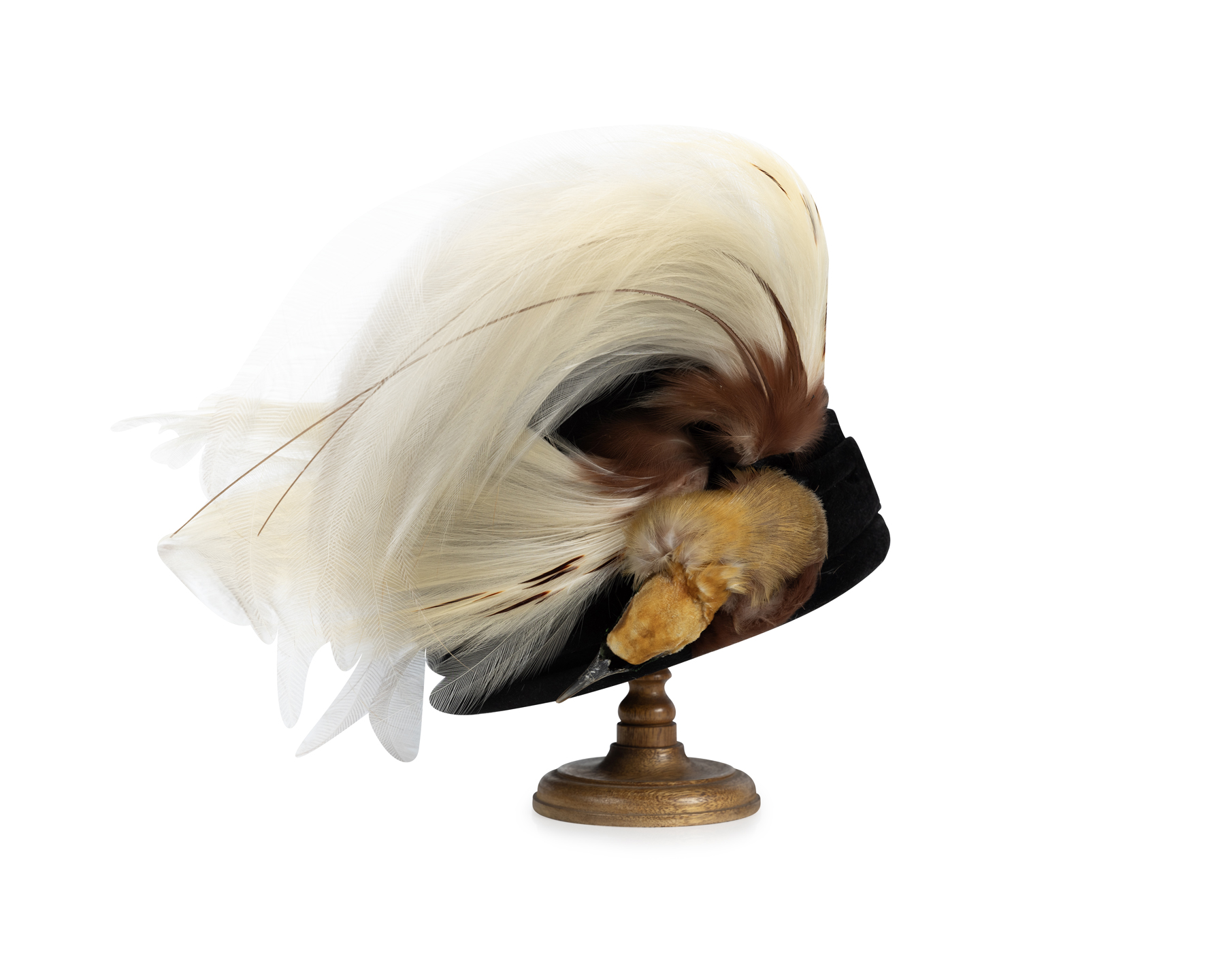
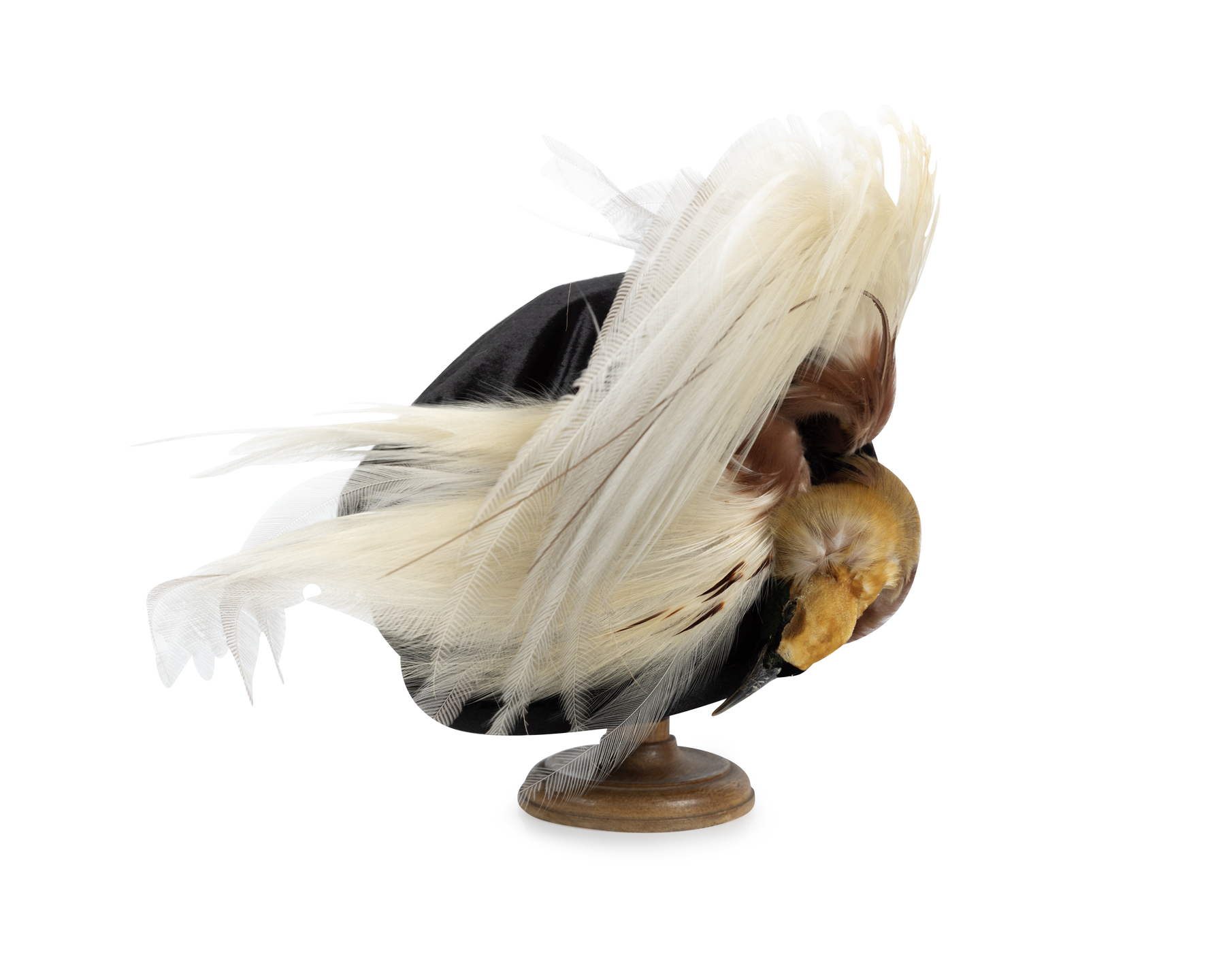
Edwardian-era Bird-of-Paradise hat. Materials: black velvet and taxidermy bird-of-paradise skin and feathers. The bird-of-paradise is either a Paradisaea apoda or Paradisaea minor, birds that live in the low- and highland forests of South-West New Guinea and the aru islands, Indonesia. The hat was retailed by a store in Amsterdam, indicating the role Dutch colonialism played in making bird-of-paradise skins and feathers available to Western consumers. During the “Plume Boom” (1880-1914), when millions of birds across the globe were hunted and killed for their feathers, bird-of-paradise plumes were the most sought after avian commodites due to their exceptional aesthetic qualities. At the height of feather fashions 30,000-80,000 bird-of-paradise skins were exported annually to the feather auctions of London, Paris, Amsterdam and New York and this trade brought many bird-of-paradise species to the brink of extinction. For anyone handling bird-of-paradise skins the rare beauty and sumptuous quality of their plumage cannot go unnoticed. Nor is it hard to imagine why they have for millennia been ornaments, commodities and gifts. Yet as Arun Saldanha adamantly argues:
“When Malay, Polynesian, Portuguese, Dutch and English traders became fascinated with the rare birds, they were also merely dis-covering – making appear – objective effects of sexual selection accumulated over a few tens of thousands of years. No heroic entitlement can be conferred to anyone in this story: evolutionary creativity is absolutely without subject.” [1]
For more information see: https://fashioningfeathers.info/ or for Merle’s publication on this topic see: Patchett, M (2019) The Biogeographies of the Blue Bird-of-Paradise: From Sexual Selection to Sex and the City, Journal of Social History, Volume 52, Issue 4, Summer 2019, Pages 1061–1086, https://doi.org/10.1093/jsh/shz013 ; Patchett M. (2019) Archiving. Trans Inst Br Geogr. 2019; 44: 650–653. https://doi.org/10.1111/tran.12325 ; Patchett, M. (2022). Flights of Fancy: Speculative Taxidermy as Pedagogical Practice. In: Williams, N., Keating, T. (eds) Speculative Geographies. Palgrave Macmillan, Singapore. https://doi.org/10.1007/978-981-19-0691-6_15
[1] Arun Saldanha ‘Two Birds of Paradise in North Holland, 1592: The Gift in the Exotic’, Parallax, 2010, vol. 16, no. 1, 68–79.