New foyer display: Ice Age Fossils, March 2026
30th September 2026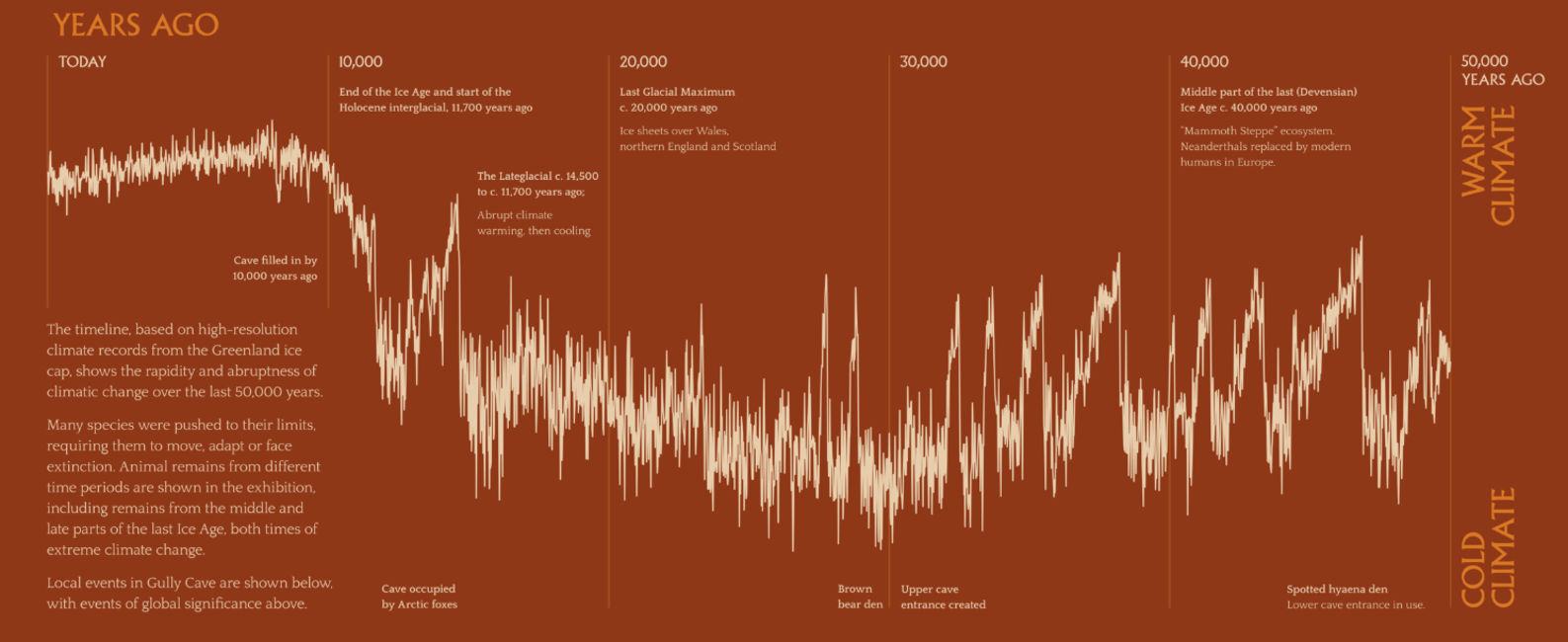
Our latest display presents fossil material from Gully Cave in the Mendip Hills, Somerset, a longstanding research excavation led by Professor Danielle Schreve. The middle and late parts of the last Ice Age were times when many species were pushed to their limits, forced to move, adapt or face extinction. The cave is one of the best records in western Europe in demonstrating how species cope with abrupt climate change.
These remains date to the middle part of the last Ice Age (40-50,000 years ago) are some of the oldest discovered in the cave. They reveal a vanished ecosystem of rich savanna-like grasslands. All are from young prey animals hunted by spotted hyaenas, large carnivores once common in Britain. The single flint flake shows that early humans visited the cave briefly.
1. Part of the forelimb of an extinct steppe bison
2. Woolly rhino humerus with hyaena gnawmarks
3. Baby woolly rhino upper jaw and milk teeth
4. Partial mandible of spotted hyaena
5. Lower jaw of a reindeer calf with milk teeth and permanent teeth erupting below
6. Top of cranium with antler base stubs of a reindeer calf
7. Lower jaw of a young red deer mandible
8. White patinated struck flint flake
All c.40-50,000 years old